

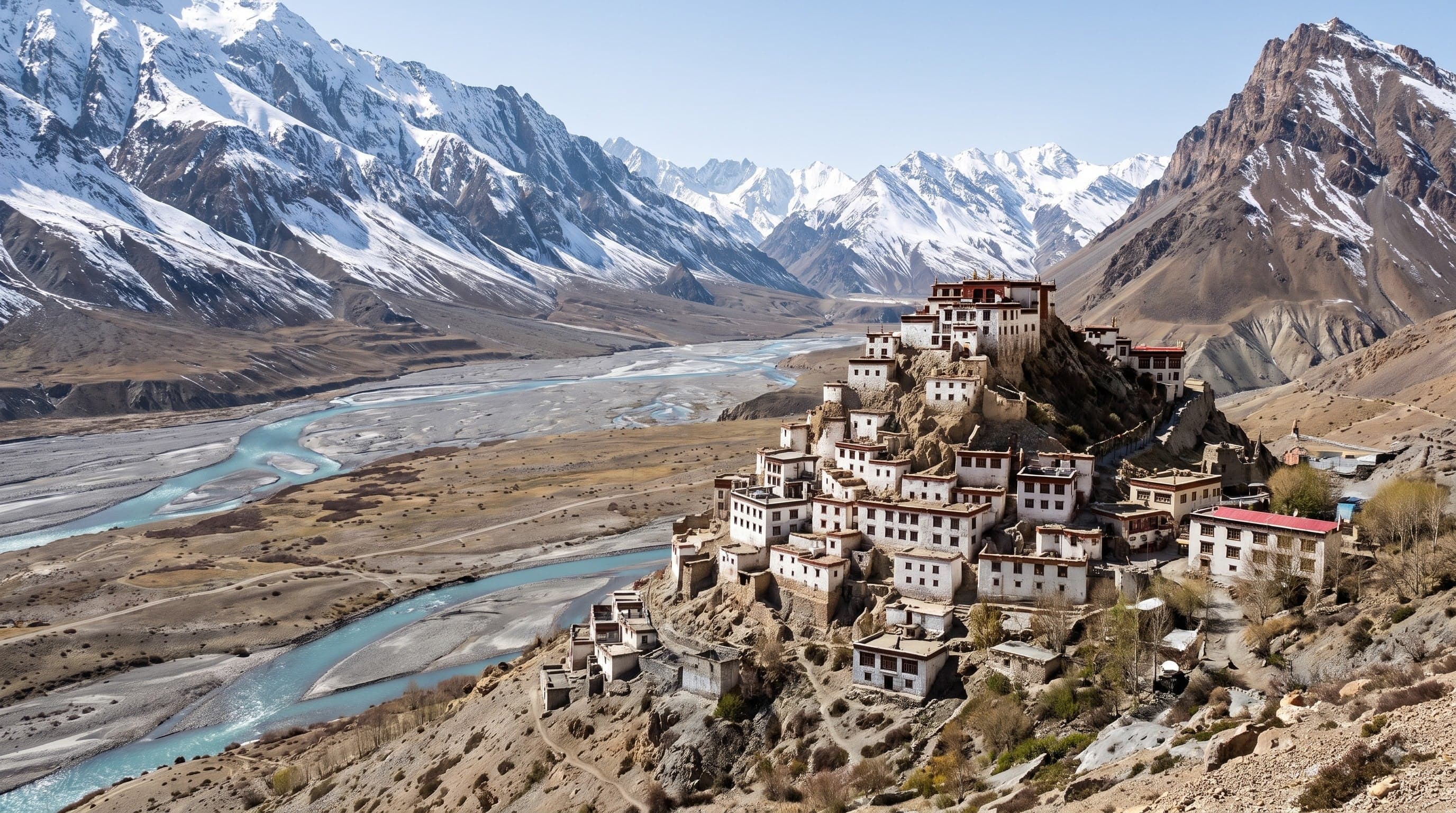
High Desert, Silent Gompas
Spiti Valley & the Trans-Himalaya
Traversing the rain-shadow desert of the trans-Himalaya, this high-altitude circuit follows ancient trade corridors through Kinnaur into Spiti Valley, exploring thousand-year-old mud gompas, cliffside citadels, and turquoise glacial lakes.
The Story
What happens when you arrive
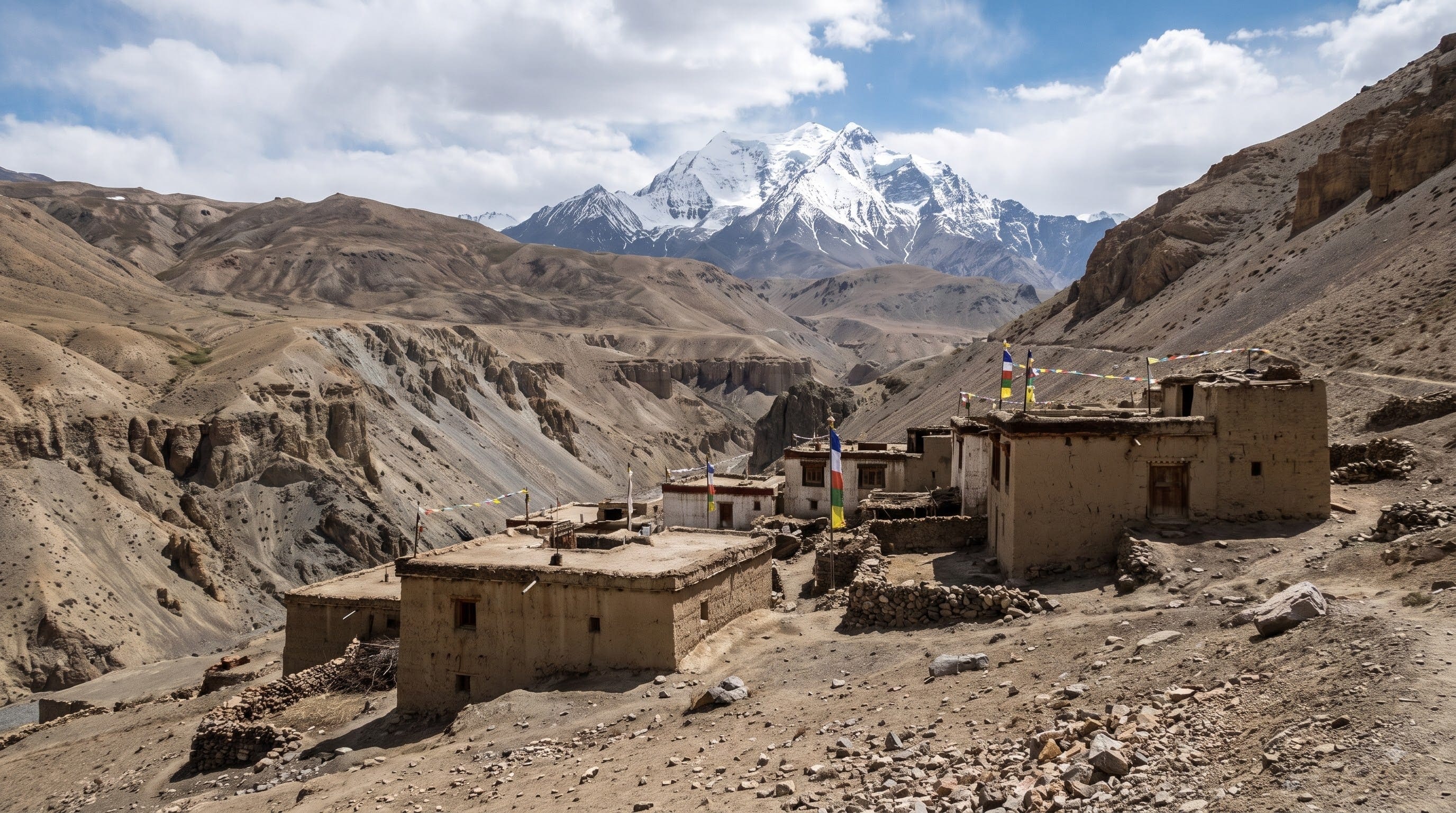
Cutting through vertical granite gorges along the Sutlej River, the road climbs into Kinnaur's apple valleys facing the sacred Kinnaur Kailash massif. Higher still, the landscape turns to bare scree and alluvial plateaus where thousand-year-old mud chapels at Tabo Monastery preserve early Buddhist art.
From the cliff fortress of Dhankar to the world's highest permanently inhabited hamlets at Hikkim, Komic, and Langza, whitewashed gompas rise above arid canyons. Crossing the 4,551-metre Kunzum Pass, the route circles the crescent shores of Chandratal Lake before crossing glacial riverbeds into Manali.
Cultural Context
The Indo-Tibetan Renaissance and Arid Survival
Spiti preserves eleventh-century Western Tibetan Buddhism untouched by regional conflicts. Founded in 996 CE, Tabo Monastery houses pristine Kashmiri-influenced wall murals, while high-altitude hamlets maintain communal survival through rotational glacial meltwater irrigation channels (kuhls).
Itinerary
What you will do
A day-by-day progression designed to pace altitude, technical craft immersion, and meaningful host engagement.
Arrival in Chandigarh and Ascent to Shimla
You arrive at Chandigarh Airport or Railway Station, where your tour manager greets you. You board your high-clearance mountain vehicle and begin the ascent into the Himalayan foothills along the national highway to Shimla. You check in to your hotel and spend the evening relaxing. If time permits, you take a gentle stroll along Mall Road and The Ridge to see Christ Church. You dine at your hotel in the evening.
Shimla to Sarahan and the Sutlej Valley
Following breakfast, you begin the journey along the historic Hindustan-Tibet road (NH5). You drive through the apple-growing belt of Theog and Narkanda, descending into the dramatic rocky gorge of the Sutlej River. Depending on road conditions, you can take a detour to Hatu Peak for panoramic views across the snow-capped Himalayan ranges. You continue through Rampur to Sarahan or Rampur, check in to your hotel, and spend the evening enjoying the peaceful mountain surroundings.
Sarahan to Kalpa and the Kinnaur Kailash
After breakfast, you drive deeper into the Kinnaur region along the carved rock overhangs of the Sutlej gorge. You pass Reckong Peo, the administrative capital of Kinnaur, before ascending through pine forests to the scenic village of Kalpa. Upon arrival, you take in views of the sacred snow-covered peaks of the Kinnaur Kailash Range rising directly across the valley. You visit Suicide Point with its vertical cliff drops, explore traditional Kinnauri wooden houses, and spend the evening relaxing.
Kalpa to Nako Lake, Gue Mummy and Tabo
Following breakfast, you enter the rain shadow of the trans-Himalayan desert. You travel along the Spiti River corridor to Nako village, visiting the peaceful high-altitude Nako Lake and the ancient Nako Monastery. You take a detour into the isolated border village of Gue to view the 500-year-old naturally preserved Buddhist mummy of the monk Sangha Tenzin. Continuing along barren mountain roads, you arrive in Tabo, one of the oldest continuously inhabited Buddhist settlements in the Himalayas. You dine at your guesthouse.
Tabo Monastery and Dhankar Cliff to Kaza
In the morning, you explore the historic Tabo Monastery, founded over a thousand years ago and celebrated as the "Ajanta of the Himalayas." You enter its ancient mud-brick sanctums to view intact thousand-year-old wall murals and clay sculptures. Later, you drive to Dhankar Monastery, perched dramatically on a sheer rocky cliff spur overlooking the confluence of the Spiti and Pin Rivers. You explore the ancient gompa and take in sweeping valley views before continuing to Kaza, the main town of Spiti Valley.
High Settlements: Hikkim, Komic and Langza
After breakfast, you embark on an excursion across the high-altitude plateau above Kaza. You visit Hikkim, home to the world's highest post office at 4,400 metres, where you can send postcards home. You continue to Komic, one of the highest motorable villages in the world at 4,587 metres, visiting its hilltop monastery. Later, you visit Langza village, famous for its giant Buddha statue looking out over fossil-rich shale beds beneath Chau Chau Kang Nilda peak. You return to Kaza for dinner.
Key Monastery and Kibber Snow Leopard Country
Following breakfast, you visit the iconic Key Monastery, the largest and most prominent Buddhist monastery in Spiti, constructed in layers up a conical hill overlooking the Spiti River. You explore its ancient prayer halls, monk residences, and rooftop viewpoints. Next, you proceed to Kibber village, located at 4,270 metres within the Kibber Wildlife Sanctuary, known as a primary habitat for the endangered snow leopard and Himalayan ibex. You return to Kaza in the late afternoon.
Kaza to Chandratal Lake via Kunzum Pass
After breakfast, you begin the crossing from Spiti toward Lahaul. You ascend the winding mountain switchbacks of the majestic Kunzum Pass (4,551 metres), walking around the pass chortens adorned with fluttering prayer flags. From the pass, you take the rough access road toward Chandratal Lake ("Moon Lake"). You take a gentle walking trail from the designated parking area to the shores of the crystal-clear crescent lake, admiring its turquoise waters beneath towering bare scree slopes. You overnight near Chandratal or return to Kaza.
Chandratal / Kaza to Manali via Batal and Chhatru
You depart early in the morning, traversing the rugged and adventurous mountain route across the Chandra Valley. You drive through the glacial riverbed tracks of Batal and Chhatru, crossing fast-flowing streams and passing beneath towering snow peaks. You emerge on the highway to Manali, arriving in the afternoon and checking in to your hotel. You spend a relaxing evening resting after the high-altitude trans-Himalayan crossing and dine at your hotel.
Manali Valley Rest and Cedar Forests
You spend a relaxed day in Manali adjusting to lower elevations. In the morning, you take a gentle walk through the Dhungri deodar cedar forest to visit the sixteenth-century wooden pagoda of Hadimba Devi Temple. In the afternoon, you explore the village lanes and cafes of Old Manali or visit the natural thermal springs at Vashisht. You spend your final evening enjoying a farewell dinner with your tour group.
Manali to Chandigarh and Departure
Following breakfast, you check out and board your private vehicle for the return drive down the Beas River corridor through Kullu and Mandi to Chandigarh. Your tour manager arranges your drop-off at Chandigarh Airport or Railway Station in time for your onward flight or train journey.
Experience Guide
Preparation, inclusions & suitability
All ground logistics and master residencies covered. No surprise expenses.
- •**Accommodation:** 10 nights in Deluxe hotels, mountain lodges, and best-available guesthouses on twin-sharing basis (1N Shimla, 1N Sarahan/Rampur, 1N Kalpa, 1N Tabo, 3N Kaza, 1N Chandratal camp/Kaza, 2N Manali).
- •**Meals:** Daily breakfasts at all accommodations; dinners included on all 10 nights; lunches on mountain transit and excursion days.
- •**Ancient Monasteries & Sacred Sites:** Guided visits to Tabo Monastery (founded 996 CE, "Ajanta of the Himalayas"), Dhankar Monastery cliff fortress, Nako Monastery, Key Monastery (Spiti’s largest monastic seat), and the 500-year-old preserved Buddhist mummy at Gue.
- •**High-Altitude Himalayan Villages:** Excursions to Hikkim (home to the world's highest post office), Komic (one of the world's highest motorable villages), Langza (fossil village beneath Chau Chau Kang Nilda peak), and Kibber (snow leopard sanctuary buffer).
- •**High Passes & Alpine Lakes:** Crossing Kunzum Pass (4,551 metres); guided walking excursion to the shores of turquoise Chandratal Lake ("Moon Lake"); crossing Batal and Chhatru glacial riverbeds.
- •**Kinnaur Cultural Highlights:** Views of the sacred Kinnaur Kailash Range and Suicide Point in Kalpa; transit along the Sutlej River gorge.
- •**Mountain Logistics & Safety:** Sturdy 4x4 / high-clearance SUV transport with experienced mountain driver for the entire circuit from Chandigarh to Manali and return, including fuel, toll taxes, parking fees, and driver allowances; onboard emergency first-aid kit and portable medical oxygen cylinder.
- •**Guiding & Management:** Services of an experienced Tour Manager / accompanied trans-Himalayan specialist guide throughout.
- •**Permits & Admissions:** Inner Line Permits for foreign nationals and entrance permits for scheduled monasteries and monuments.
- •**Orientation & Hydration:** Mandatory high-altitude acclimatisation briefing; 2 bottles of packaged drinking water per person per day.
- •Government of India Goods & Services Tax (GST) / statutory taxes.
- •Airfare or long-distance train tickets to/from Chandigarh.
- •Personal high-altitude gear, sleeping bags, and specialized warm-weather clothing.
- •Personal expenses such as laundry, phone calls, satellite communications, alcoholic beverages, and extra food.
- •Travel, medical, and emergency high-altitude medical evacuation insurance (mandatory for remote mountain travel).
- •Early check-in and late check-out at hotels.
- •Gratuities and tips for drivers, local guides, and camp staff.
- •Any emergency accommodation or re-routing expenses resulting from landslides, cloudbursts, road closures, or force majeure.
Who this is for
Experienced travellers comfortable at altitude who want a cold desert and thousand-year-old monasteries. Eleven days, high passes, thin air.
Anyone with heart or breathing conditions, or unwilling to spend days without phone signal.
Frequently Asked Questions
Field protocols & visas
Protocols
Ethical guidelines
These are the conditions of travelling here. They are set at design, briefed before departure, and not negotiable on the ground.
Schedule
Upcoming departure dates
| Departure Dates | Availability | Price per person | Action |
|---|---|---|---|
| Dates on request | Available on request | from ₹1,65,000 per person | Enquire → |
Prices are per person, based on two people sharing a room. Travelling alone or want your own room? Tell us and we'll quote it.
Deposit 25–30% on confirmation. Balance due 30 days before travel. Prices exclude applicable taxes. Cancellation policy →
Explore Further
Related journeys in our network
Plan your journey: High Desert, Silent Gompas
Tell us your preferred dates and group size. We will verify availability against our ground network and respond within 24 hours.
Field office response within 24 hours · No automated booking engines